


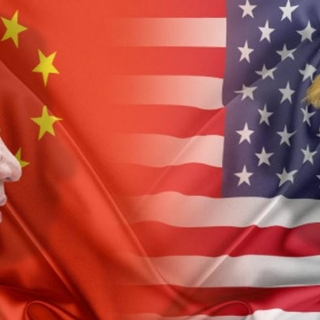
The US and China ended two days of high-stakes trade talks with a plan to revive the flow of sensitive goods — a framework that now awaits the blessing of Donald Trump and Xi Jinping.
After about 20 hours of negotiations in London, US Commerce Secretary Howard Lutnick said the two sides had laid out a framework for implementing the Geneva consensus that lowered tariffs last month. "First of all, we have to get rid of the negatives," he said. "Now, we can move forward to try to have positive trade, to increase trade."
While the more upbeat tone should reassure investors worried about the decoupling of the world's largest economies, details are scant and the deal could still be scuttled by top leaders. The discussions also did little to fix issues such as China's large trade surplus with the US, and Washington's belief that Beijing is dumping goods on its markets.
Concluding a marathon round of bargaining that lasted more than 12 hours on Tuesday, Lutnick said China had pledged to speed up shipments of rare earth metals critical to U.S. auto and defense companies, while Washington would ease some of its own export controls — indicating progress had been made on two of the thorniest issues in bilateral relations.
The U.S. and Chinese delegations will take the proposals back to their respective leaders, according to China's chief trade negotiator Li Chenggang. The negotiations were "in-depth and candid," he told reporters in brief remarks before midnight outside Lancaster House, a Georgian-era mansion near Buckingham Palace that is hosting this week's meetings.
In additional comments on Wednesday, He Lifeng, the Chinese vice premier leading Beijing's delegation, called on the two countries to make use of their trade negotiation mechanisms to "enhance consensus, reduce misunderstandings and strengthen cooperation" after the talks, state broadcaster China Central Television reported.
Explainer: What's at Stake if the U.S.-China Trade War Drags On
Market reaction to the announcement was muted, with U.S. stock futures moving lower and the offshore yuan barely changing. China's benchmark onshore stock index rose 0.8% at the close, the most in nearly a month. European stocks were little changed.
"Markets will likely welcome the shift from confrontation to coordination," said Charu Chanana, chief investment strategist at Saxo Markets. "We're not out of the woods yet — it's up to Trump and Xi to agree and enforce a deal."
China's Commerce Ministry did not respond to a request for comment. Foreign Ministry spokesman Lin Jian said he had no further information to provide. (alg)
Source: Bloomberg
Renewed tensions between the United States and Russia have resurfaced following an incident involving an oil tanker, sparking market concerns about potential disruptions to global energy supplies. Was...
According to a report from the US Department of Labor (DOL) released on Thursday, the number of Americans filing new applications for unemployment insurance rose to 208,000 for the week ending January...
Geopolitical issues have heated up again after statements and political signals from the United States sparked speculation about a possible US takeover of Greenland. Although no concrete action has be...
Private employment rose less than economists expected in December, according to the ADP report. Private employment rose 41,000 (Estimate +50,000) in December, compared with a revised -29,000 in Novem...
Greenland is not only a strategic location, but also a world-class mineral repository. The island holds vast reserves of rare earth elements (REEs), essential for modern technology. These minerals are...
Oil prices stabilized on Thursday (February 12th), as the market reassigned a risk premium to US-Iran tensions despite US inventory data showing swelling domestic supplies. This movement confirms one thing: geopolitical headlines are still more...
Gold prices weakened slightly on Thursday (February 12th), as more solid US employment data reduced market confidence in an imminent Federal Reserve interest rate cut. The strong employment data prompted market participants to shift expectations of...
The Hang Seng Index reversed its downward trend in Hong Kong on Thursday (February 12th), weakening by around 0.9% to around 27,000 after a strong session earlier. This decline halted the momentum of the short term rally, as investors began to...